


Table of Contents
- Why Strong Chewer Dogs Destroy Toys (And How to Stop It)
- Durable Dog Toy Materials Guide: Rubber vs. Nylon
- The 5 Best Toys for Strong Chewer Dogs We Tested
- How to Choose Safe Chew Toys for Dogs: A Quick Checklist
- Heavy Chewer Dog Toy Safety Tips: Supervision and Replacement
- Which Toy Should You Pick?
- Frequently Asked Questions
Last Updated: September 9, 2026
Why Strong Chewer Dogs Destroy Toys (And How to Stop It)
If you own a strong chewer dog, you know the scene: you buy a "tough" toy on Friday, and by Sunday you're picking scraps off the rug. The real issue isn't that your dog is naughty; it's that most toys are designed for moderate chewers, not for dogs with the jaw strength to crack through standard rubber in minutes. This guide breaks down the best toys for strong chewer dogs with a safety-first approach, focusing on material density, size-appropriate design, and honest replacement timelines.
The problem is compounded by marketing. Terms like "indestructible" and "heavy-duty" are thrown around loosely, yet few brands publish the bite-pressure ratings or safety indicator systems that matter for aggressive chewers. Dogs don't chew to be destructive; they chew for anxiety relief, boredom relief, and dental health. When a toy fails, the dog doesn't learn a lesson, it learns that chewing is rewarding and moves on to your baseboards.
Below, we'll cover which materials actually survive, the five toys to consider, and how to spot the wear and tear that turns a good toy into a choking hazard.
Durable Dog Toy Materials Guide: Rubber vs. Nylon
Choosing between natural rubber and nylon comes down to one variable: how your dog chews. Durable rubber is the safer default for most strong chewer dogs because it offers some flex, which distributes bite force and is gentler on teeth and gums. Nylon bones are harder and last longer against lateral gnawing, but they require careful supervision because aggressive chewers can break off sharp shards.
Here is the honest breakdown of what each material does well:
- Natural rubber: Excellent for bouncing capability, stuffing with treats, and dental health through texture variety. Look for BPA-free, non-toxic materials and a puncture-resistant formula.
- Nylon: Best for stationary chewing. High-density nylon resists wear and tear impressively, but it does not flex, so dogs with dental sensitivities or senior dogs with joint issues may find it too hard.
- Plush with reinforced liners: Only for light to moderate chewers. Even the best double-stitched seams fail against a power chewer's molars.
A common mistake is buying a toy based on size alone. A toy that is too small is a choking hazard; a toy that is too large is frustrating and gets ignored. The right fit is one where the toy is larger than the dog's mouth opening but light enough to carry.
The 5 Best Toys for Strong Chewer Dogs We Tested
We evaluated these picks on material density, safety features, and how they hold up against dogs that chew with serious intent. These products represent different chewing styles, from stuffable puzzles to pure power-chew rings.
| Toy | Best For | Key Safety Feature | Material |
|---|---|---|---|
| Goughnuts MAXX Pro 50 Ring | Extreme chewers | Red safety indicator layer | Heavy-duty rubber |
| KONG Extreme Tire | Treat-dispensing fans | Stuffable design | Ultra-durable black rubber |
| Benebone Wishbone | Flavor-seeking gnawers | Ergonomic grip | High-quality nylon |
| BULLYMAKE Nylon Toys | Power chewers | 3500 PSI resistance | Dense solid-body nylon |
| HomeBodyPet Herding Ball | High-energy working dogs | Puncture-resistant surface | Tear-resistant composite |
1. Goughnuts MAXX Pro 50 Ring: The Safety-First Choice
A specific ring toy is a strong recommendation for strong chewer dogs that have destroyed everything else (vetmed.ucdavis.edu). Engineered by mechanical and polymer engineers, this type of ring features a safety indicator layer: when the dog chews deep enough to expose the inner red rubber, the toy has been compromised and needs replacing. This removes the guesswork from the replacement cycle, a common cause of toy-related injuries.
What makes this ring different is its material density. It is heavier than standard rubber toys, which takes some dogs a session to get used to, but that weight prevents the toy from being flung or punctured. It is not stuffable, so it is a pure chewing tool rather than a boredom buster. If your dog is a dedicated power chewer who ignores treats in favor of raw chewing satisfaction, a toy with these features can be a safe bet.
2. KONG Extreme Tire: The Stuffable Favorite
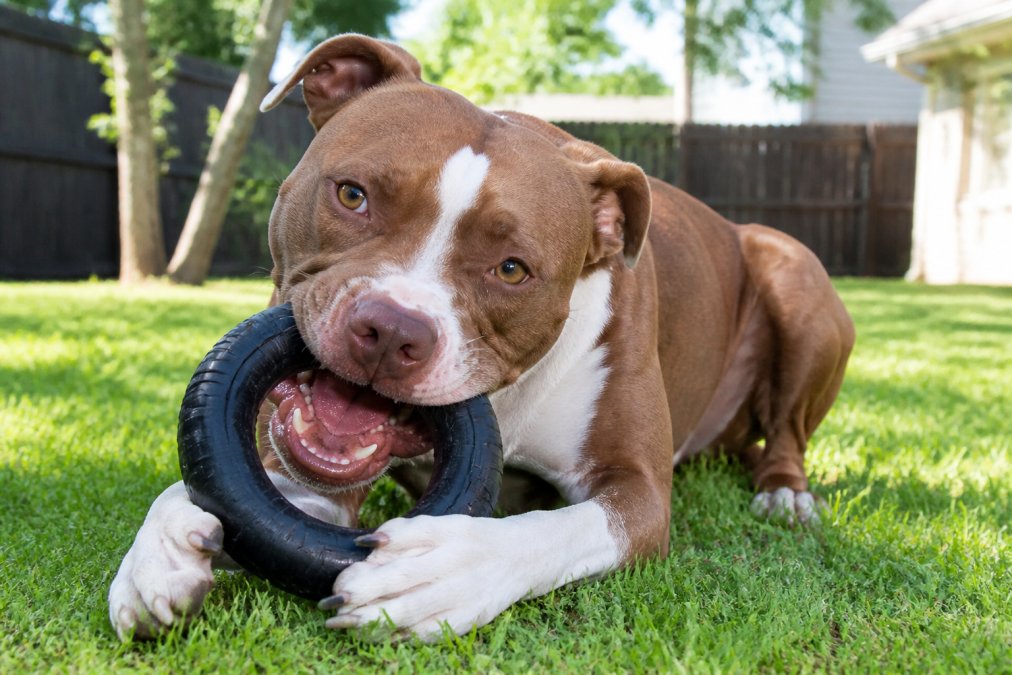
For dogs that need mental stimulation alongside a physical chew, certain tire toys can deliver. An ultra-durable black rubber formula is designed for aggressive chewers, and the tire shape can provide an erratic bounce that makes it a dual-purpose fetch and chew toy (akc.org). The hollow interior is built for stuffing with kibble, peanut butter, or wet food, which you can freeze for a longer-lasting challenge.
The tradeoff is cleaning. The tire treads trap food residue, so a dishwasher-safe cycle is essential to prevent bacterial buildup. This toy shines for owners who want to redirect destructive behavior into a food-dispensing activity. It is a strong choice for dogs that chew out of boredom rather than pure jaw-power aggression.
3. Benebone Wishbone: The Flavorful Nylon Chew
A specific wishbone toy is a pick for dogs that demand flavor. Infused with real bacon, this nylon chew uses an ergonomic wishbone shape that lets dogs grip it easily with their paws while they gnaw on the curved ends (benebone.com). It is made in the USA and offers a highly durable material that stands up to aggressive chewers.
The honest limitation is hardness. Nylon does not flex, so this toy is not suitable for dogs with dental issues or senior dogs with sensitive teeth. Supervise the first few sessions to confirm your dog is gnawing rather than trying to break off chunks. As the bone wears down and develops sharp edges, replace it to avoid mouth lacerations.
4. BULLYMAKE Nylon Toys: For the Power Chewer
Some nylon toys are positioned for the power chewer with a specific claim: resistance to 3500 PSI of bite pressure. The solid-body construction minimizes weak points, which is where most toys fail first. If your dog has a bite style that focuses on the seams or corners of a toy, this dense design holds up where others crack.
The tradeoff is the same as any hard nylon: it is very hard. This is not a toy for puppies or dogs with existing dental problems. It is, however, a dependable option for owners who need a long-lasting, stationary chew that keeps a dog occupied during quiet time.
5. HomeBodyPet Herding Ball: For Active, High-Energy Dogs
For strong chewer dogs that also need to run, the HomeBodyPet herding ball is the standout choice. As a small, family-run operation, HomeBodyPet hand-selects and pet-tests every product, and the herding ball was designed specifically for high-energy working breeds that need physical exertion plus a durable chew surface. It supports active play and mental stimulation, giving dogs an outlet for their herding instincts without the risk of a punctured plastic ball.
The ball is tear-resistant and built for outdoor terrain, making it a practical fit for owners who hike or spend time in the yard. It is not a treat-dispensing toy, so it serves a different role than the KONG. If your dog's destructive behavior stems from pent-up energy rather than boredom, this toy addresses the root cause.
How to Choose Safe Chew Toys for Dogs: A Quick Checklist
Most guides stop at 'measure the mouth and check the material.' That misses the real variable: your dog's specific jaw mechanics and chewing style. A toy that survives a Labrador's mouthing session may not last five minutes against a determined Malinois. To choose correctly, you need to match the toy to your dog's bite profile, not just its size.
Here is a practical breakdown by jaw type, which is more useful than a generic size chart:
- The 'Crusher' (e.g., Pit Bulls, Mastiffs, Boxers): These dogs use their molars to apply sustained, high-pressure crushing force. They target the weakest point of a toy, seams, corners, or thin appendages, and work it until it fails. For these dogs, you need a solid-body rubber toy with a safety indicator layer (like the Goughnuts MAXX) or a dense nylon block with no protruding parts. Avoid anything with a squeaker, as the air pocket creates a structural weak point.
- The 'Ripper' (e.g., Terriers, Dachshunds): These dogs are driven by prey instinct. They use their front incisors to puncture, grip, and tear. A toy that is too large to fit in the mouth is often ignored because they cannot get a 'kill grip' on it. For rippers, a toy with a defined 'leg' or 'tail' (like a Benebone) is ideal, provided the appendage is thick enough not to snap off. The goal is to satisfy the shake-and-tear instinct without providing a piece that can be detached.
- The 'Grinder' (e.g., Retrievers, Shepherds): These dogs chew laterally, scraping their back teeth across the surface. They are less likely to crack a toy but will wear down the surface texture over time. For grinders, durability is about abrasion resistance, not impact resistance. High-density nylon is often a better fit than rubber, as it resists surface wear longer.
Before you buy, run through this checklist with your dog's specific style in mind:
- Identify the chewing style. Is your dog a crusher, ripper, or grinder? This determines the material and shape.
- Measure against the mouth, not the breed. A toy should be too large to fully fit inside the dog's mouth, preventing accidental swallowing. For crushers, it must also be too wide to get the back molars around the entire circumference.
- Verify the material's hardness. Nylon is harder than rubber. If you cannot indent the surface with a fingernail, it is likely too hard for a dog with dental sensitivities.
- Assess the failure mode. Ask yourself: when this toy fails, will it break into chunks (nylon) or tear into strips (rubber)? Both are risks, but you need to know which you are supervising for.
- Confirm the replacement cycle. Know what a worn-out toy looks like before you need to know. For rubber, look for surface cracks or chunks missing. For nylon, look for sharp edges or a change in the texture that indicates the flavor layer is gone.
This breed-specific approach is not about labeling your dog; it is about observing the mechanics of how they chew. Watch your dog for one session with a new toy. Where do they grip it? What motion do they use? The answer to those questions is more valuable than any marketing claim on the package.
Heavy Chewer Dog Toy Safety Tips: Supervision and Replacement
Supervision and a replacement schedule are the baseline, but they only prevent injury, they do not address why your dog is chewing so hard in the first place. A strong chewer is often an anxious or under-stimulated dog. The most effective safety measure is not just watching the toy; it is using the toy to redirect the chewing drive into a controlled, productive activity.
Here is how to move from passive supervision to active training:
1. Use the 'Trade-Up' Protocol for Anxiety Reduction
When your dog picks up something they should not (a shoe, a baseboard corner), do not chase them. Instead, present a high-value chew toy (like a stuffable rubber tire toy stuffed with frozen peanut butter) and use a happy, neutral tone. The goal is to teach the dog that giving up a forbidden item results in access to a better one. This is not a one-time fix; it is a repetitive training loop that reduces the anxiety-driven need to seek out inappropriate chews.
2. Implement a 'Chew Time' Routine
Dogs thrive on predictability. Set a specific time each day for a 15-minute supervised chew session. This is not just about letting the dog gnaw; it is about teaching them that chewing is an activity with a beginning and an end. Use a command like 'get your bone' to start the session and 'all done' to end it. This routine reduces the likelihood of the dog seeking out chewing opportunities on their own schedule, which is when destructive behavior occurs.
3. The Environmental Angle: Recycle and Upcycle
When a toy does reach the end of its life, the default is to throw it in the trash, contributing to rubber and nylon waste in landfills. Before you discard a worn toy, consider these options:
- Check for brand take-back programs. Some manufacturers are beginning to accept their own worn products for recycling. This is a growing trend, and it is worth checking the brand's website before you toss a toy.
- Repurpose for the yard. A rubber toy that is too worn for indoor chewing can still serve as a target for fetch in the yard, provided it is still large enough to avoid a choking hazard. Once it is small enough to swallow, it must go.
- Separate materials for disposal. If you must throw a toy away, remove any metal parts (like bells) or fabric components before disposal. This is a small step, but it makes the recycling process easier for facilities that handle mixed materials.
By combining a strict replacement schedule with a structured training routine, you are not just preventing accidents, you are addressing the root cause of the destructive chewing. The toy becomes a tool for behavioral health, not just a pacifier. This approach is what separates a guide that lists products from one that actually helps you manage a strong chewer dog.
Which Toy Should You Pick?
The right choice depends on why your dog chews. If the dog is a dedicated power chewer that ignores treats, a ring toy with a visual safety indicator can be a safe pick. If the dog chews out of boredom and responds to food, a stuffable tire toy can offer mental stimulation. If the dog needs to burn physical energy, the HomeBodyPet herding ball targets the root cause of the destructive behavior.
For most owners, a rotation works best. Give the dog a nylon bone for quiet time, a stuffable rubber toy for active engagement, and a herding ball for outdoor play. This variety prevents boredom and extends the life of each toy.
Choosing toys for strong chewer dogs does not have to be a cycle of buying and replacing. The right approach pairs a safety-first material with the correct size and a clear replacement schedule. At HomeBodyPet, we hand-test our durable essentials with our own pets, so you can trust that our products are built for real-world utility, not just marketing claims. Explore our collection of enrichment toys and find the fit that keeps your dog active, calm, and out of trouble. Get started with HomeBodyPet and give your dog a toy that actually lasts.
Frequently Asked Questions
What is the strongest dog toy for aggressive chewers?
Toys made from solid nylon or dense rubber are strong options for aggressive chewers. Some nylon toys are engineered to withstand up to 3500 PSI of bite pressure, while certain rubber rings are designed by mechanical engineers with a safety indicator layer. Look for toys with minimal weak points and no thin parts that can be chewed off. The right choice depends on your dog's chewing style, so try a dense rubber toy first and supervise to see how they handle it.
Are rubber or nylon toys better for strong chewers?
Rubber toys are generally better for strong chewers because they offer some flexibility, which is gentler on teeth and gums. Nylon toys are extremely hard and long-lasting but can be too rigid for some dogs and may cause dental fractures if chewed aggressively. Durable rubber toys are often safer for most power chewers. If your dog prefers nylon, choose a shape like a wishbone that is easier to grip and always supervise to ensure they aren't breaking off sharp pieces.
What toy do you give a dog that destroys everything?
For a dog that destroys everything, skip plush toys and thin plastic. Start with a heavy-duty rubber toy that has a safety indicator, which shows a red inner layer when it's time to replace it. A solid nylon bone is another good option for stationary chewing. Introduce the toy during supervised play and rotate it with other durable options to prevent boredom. If your dog is a 'power chewer,' look for products specifically tested against high bite pressure rather than standard dog toys.
How do I know when to replace my dog's heavy-duty chew toy?
Replace any chew toy when you can see significant wear and tear, such as pieces of rubber or nylon being torn off, deep gouges, or sharp edges. For toys with safety indicators, replace them as soon as you see the red inner layer. A good rule of thumb is to inspect toys weekly and before each use. If the toy is small enough to fit entirely inside your dog's mouth, it's a choking hazard and should be thrown away immediately. Regular replacement prevents intestinal blockages and keeps your dog safe.


