


Table of Contents
- What Makes a Herding Ball Durable Enough for High-Energy Dogs
- Quick Comparison: Durable Herding Balls for Dogs
- Herding Ball Size Guide: Finding the Right Fit for Your Dog
- How to Introduce a Herding Ball to Your Dog
- Safety Tips for Dog Herding Balls: Supervised vs. Unsupervised Play
- Repair and Maintenance: Making Your Herding Ball Last
- DIY Enrichment Alternatives for High-Energy Breeds
- Conclusion
- Frequently Asked Questions
Last Updated: September 18, 2026
What Makes a Herding Ball Durable Enough for High-Energy Dogs
A durable herding ball for dogs is an oversized, hard-to-pick-up toy built to survive pushing, nose-nudging, and full-speed chasing without splitting at the seams. At HomeBodyPet, we hand-select and pet-test the gear we sell.

Three things decide whether a herding ball survives:
- Wall thickness and material. Heavy-duty rubber or thick inflatable skins flex and recover. Thin plastic cracks on the first hard impact.
- Shape retention. A ball that dents or goes egg-shaped stops rolling true, and a dog loses interest fast.
- Surface traction. A slightly grippy surface lets your dog push it with a nose or paw instead of sliding off it.
Quick Comparison: Durable Herding Balls for Dogs
The best durable herding ball for most high-energy dogs is the Herding Ball for Dogs, 17.7" Inflatable Chase & Push Toy at $34.99. It is oversized by design, so your dog pushes and chases rather than picking it up and chewing it.
Here is how the options compare:
| Product | Price | Best For | Key Strength |
|---|---|---|---|
| Herding Ball for Dogs, 17.7" Inflatable Chase & Push Toy | $34.99 | High-energy herding breeds | Oversized 17.7" design, inflatable, chase and push play |
| Glow-in-the-Dark Squeaky Dog Ball | $9.99 | Evening fetch, low light | Non-toxic glowing rubber, built-in squeaker |
| Macaron Woven Rope Dog Toy | $19.99 | Tug and chew sessions | Handwoven cotton, dental friction fibers |
| Dog Dental Chew Toy for Healthy Teeth & Gums | $14.99 | Chewers who need redirection | Ridged TPR rubber, treat-fillable core |
| Snuffle Play Ball | $24.99 | Mental enrichment, rainy days | Fleece pockets hide treats, slows eating |
| Pet Rubik's Cube Snuffle Toy | $28.73 | Puzzle-focused dogs | Multi-layered polar fleece folds |
| Foam Chew Bone Dog Toy | $17.99 | Puppies and senior dogs | Lightweight foam, gentle on worn teeth |
| Squeaky Latex Bunny Dog Toy | $14.99 | Gentle chewers, indoor fetch | Soft natural latex, prey-sound squeaker |
Herding Ball Size Guide: Finding the Right Fit for Your Dog
The right herding ball size is one your dog cannot fit in its mouth. For most medium and large herding breeds, that means 15 to 18 inches, which is why the 17.7-inch herding ball suits dogs from Corgis up to Australian Shepherds.
| Dog Size | Shoulder Height | Ball Diameter | Play Style It Supports |
|---|---|---|---|
| Small herder (Corgi, Sheltie) | Under 14 in | 12-15 in | Nose-push, short drives |
| Medium herder (Heeler, Border Collie) | 14-20 in | 15-18 in | Full-speed push, fence-line driving |
| Large herder (Aussie, Collie) | 20-24 in | 17-20 in | Long-distance chase, hard direction changes |
| Giant/athletic mix | Over 24 in | 20-24 in | Sprint-and-brace play |
A quick way to check fit before you commit:
- Ball is too large to fit inside your dog's mouth
- Your dog can rest a paw on it without it rolling away instantly
- Your dog can see over the top of the ball when standing
- There is enough open ground to push it at least 15 feet
How to Introduce a Herding Ball to Your Dog
Introduce a herding ball slowly, in short sessions, with you in control of the ball. Most dogs need two or three sessions to learn that pushing is the game.
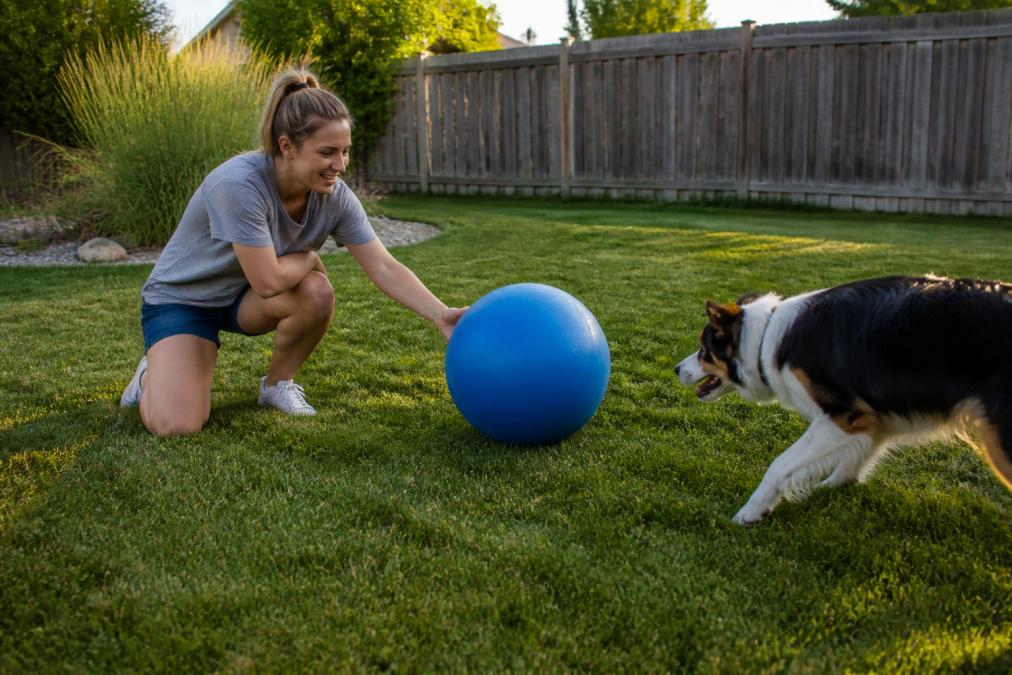
Start like this:
- Let your dog sniff it first. Leave the ball still on the ground and let your dog investigate with no pressure.
- Roll it gently by hand. A slow roll from you teaches the movement without triggering a chase reflex.
- Reward the first nose touch. Any contact with the ball earns praise or a treat.
- Step back and let your dog push. Once your dog nudges it, stop helping. Let the ball be the reward.
- End on a win. Two or three minutes is plenty for session one.
Safety Tips for Dog Herding Balls: Supervised vs. Unsupervised Play
Safety tips for dog herding balls come down to one rule: supervised play only. A herding ball is a large, moving object, and a dog that fixates on it can run itself ragged or crash into obstacles.
The supervised play protocol
Supervised play is a structured session with a beginning, a middle, and a hard stop.
- Warm-up (2 minutes). A slow walk or a few easy recalls before the ball comes out. Cold muscles and hard direction changes cause soft-tissue injuries.
- Work phase (8-12 minutes). The ball is in play, and you control the pace by how hard you roll it. Keep the surface flat and clear of rocks, holes, and fence corners.
- Cool-down (2 minutes). Ball goes away, dog gets water, and one easy obedience rep brings focus back to you.
- Hard stop at 15 minutes. Even if your dog is still begging. Herding breeds will not self-limit, and the drive that makes them good at this game makes them run past their limits.
The unsupervised rule, and why it is absolute
Unsupervised play is where injuries happen. A dog left alone with a herding ball can develop obsessive behavior, overheat, or wear down paw pads on hot pavement. ASPCA pet care guidance on exercise and heat safety recommends watching for signs of overexertion, especially in warm weather.
Herding Ball for Dogs — 17.7" →
Breed-specific risk: not all herders wear a ball the same way
The three most common herding breeds push a ball very differently, which changes injury risk and wear pattern.
- Border Collies work with a low, crouched stalk and explosive bursts, generating the most hard stops per session, which loads the shoulders and hips. They eye the ball rather than bite it, so wear shows up as surface scuffing and seam stress rather than punctures.
- Australian Cattle Dogs (Heelers) are grippers and nippers by instinct, far more likely to bite at the ball, especially when it stops rolling. Expect valve and seam damage first, and enforce the no-bite rule harder.
- Australian Shepherds are the most likely to body-block and brace against the ball with chest and shoulders. That is easier on the ball but harder on the dog's front assembly, so watch for shoulder soreness the day after a long session.
Stop rules: when to end the session immediately
Watch for these red flags and stop the session:
- Panting that does not settle after a two-minute break
- Glazed focus where your dog ignores your voice
- Limping, or favoring a paw or shoulder
- Any attempt to bite or puncture the ball
- Repeated circling or staring at the ball when it is not moving
Joint health matters too. Repetitive hard stops on slick surfaces stress shoulders and hips, so grass or packed dirt beats concrete. If your dog is over seven or has cruciate or hip issues, halve session length and keep the ball moving in straight lines.
Repair and Maintenance: Making Your Herding Ball Last
A herding ball lasts longer with about two minutes of care per week: rinse it, dry it, check the seams, and store it out of direct sun.
| Task | Frequency | Why It Matters |
|---|---|---|
| Rinse with water | After each outdoor session | Removes dirt that abrades the surface |
| Check seams and valve | Weekly | Catches small failures before they spread |
| Top up air pressure | Weekly | Keeps shape retention and true roll |
| Store indoors, out of sun | Always | Heat and UV degrade inflatable materials |
DIY Enrichment Alternatives for High-Energy Breeds
Herding balls are one tool, not the whole toolkit. On rainy days, or when your dog needs mental work rather than running, enrichment alternatives fill the gap:
- Snuffle work. Hide kibble in a snuffle ball or folded blanket and let your dog forage. This delivers mental stimulation without joint impact.
- Frozen treat toys. Stuff a treat-fillable chew toy and freeze it, stretching a five-minute snack into a 20-minute project.
- Tug and rope play. A woven rope toy gives a herding breed something to grip and shake, satisfying the bite-and-shake instinct.
- Training games. Teach a new trick or practice loose-leash work. Ten minutes of focused training tires a smart dog faster than thirty minutes of running.
Conclusion
The hard part is not finding a herding ball. It is finding one that survives month three, when the novelty has worn off and your dog is still going full speed.

Frequently Asked Questions
What is the most durable herding ball for dogs?
The most durable herding ball for dogs is one made from thick, puncture-resistant material. Inflatable options like the HomeBodyPet 17.7-inch Herding Ball use heavy-duty construction that resists popping, while still being lightweight enough for dogs to push. Look for reinforced seams and non-toxic materials. For aggressive chewers, no ball is truly indestructible, so supervised play and regular inspection are essential to make any herding ball last.
Do herding balls work for dogs that aren't herding breeds?
Yes, herding balls work for many non-herding breeds. Any dog with high prey drive or lots of energy can enjoy chasing and pushing a large ball. Breeds like terriers, huskies, and retrievers often take to herding balls because the movement triggers natural chase instincts. The key is matching the ball size to your dog's build and introducing it slowly. Even mixed breeds with no herding background can benefit from the physical exercise and mental stimulation.
How do I choose the right size herding ball for my dog?
Choose a herding ball size based on your dog's height and mouth size. A good rule: the ball should be large enough that your dog cannot easily pick it up with their jaws. For most medium to large breeds, a 17.7-inch ball like the HomeBodyPet Herding Ball works well. Smaller dogs may need a ball around 10 to 12 inches. Always supervise the first few sessions to see if your dog can push the ball comfortably without strain.
Is there a truly indestructible ball for dogs?
No ball is completely indestructible, especially for aggressive chewers. However, some materials come close: heavy-duty rubber, ballistic nylon covers, and thick inflatable designs offer the best durability. The HomeBodyPet Herding Ball is designed to resist popping during active play, but it is not a chew toy. For dogs that fixate on chewing, rotate in durable chew toys and use the herding ball only for supervised chasing and pushing games.


